
Benefits of Small Batch Botanical Skincare
Table of Contents
- What Small Batch Botanical Skincare Means
- Why Freshness and Ingredient Quality Matter
- Understanding Botanical Skincare Ingredients
- Quality Control and Batch Consistency
- How to Choose Botanical Skincare for Your Needs
- Botanical Skincare Shelf Life and Storage
- Real Results from Real Ingredients
- Frequently Asked Questions
Last Updated: October 13, 2026
What Small Batch Botanical Skincare Means
Small batch botanical skincare refers to handcrafted products made in limited quantities using plant-based ingredients rather than synthetic chemicals. At Pound Of Love Naturals, we blend botanical oils, butters, clays, and herbs in each formulation.
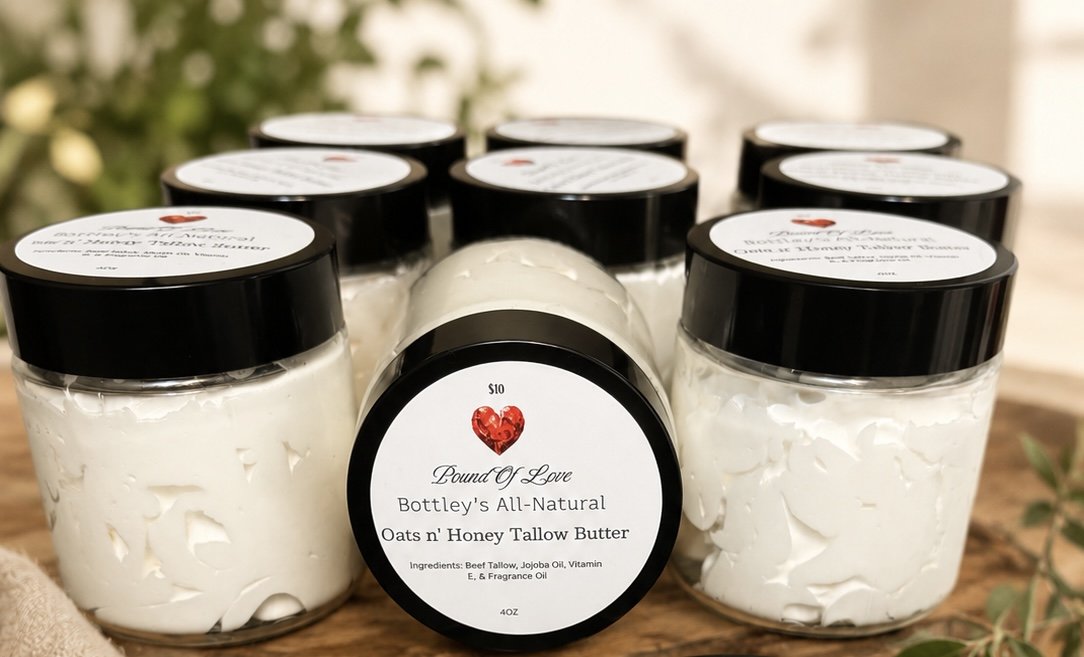
The difference comes down to control and freshness. Mass-produced ingredients sit in warehouses for months; small-batch production shortens the timeline from formulation to your hands, preserving the potency of delicate botanical compounds.
This approach also allows for greater ingredient transparency, since there's no need for the chemical stabilizers and synthetic fragrances mass manufacturers rely on.
Why Freshness and Ingredient Quality Matter
Botanical ingredients lose potency over time. Turmeric powder's active compounds degrade once exposed to air, and rose water's aromatic and skin-soothing properties weaken after a year in a bottle.
Small-batch production compresses the timeline between creation and use: a bar made last month is fresher than one manufactured six months ago.
Ingredient sourcing shifts too. Mass producers source for cost and shelf stability; small-batch makers like Pound Of Love Naturals prioritize potency and purity, selecting high oleic sunflower oil, grass-fed tallow, and botanical powders for their antioxidant density.
Combination matters too: pairing turmeric with calendula's soothing action creates synergistic effects single-ingredient products cannot match.
Understanding Botanical Skincare Ingredients
Botanical skincare relies on plant-derived compounds used for centuries across cultures. They contain active compounds, antioxidants, vitamins, and fatty acids that your skin recognizes.
Common ingredients include turmeric (brightening), rose water (toning and hydration), African black soap (clarifying), and plant oils like jojoba, coconut, and avocado.
What distinguishes botanical skincare from "natural" marketing is specificity.
Potency depends on processing. Cold-pressed oils retain more nutrients than heat-extracted ones, and powdered botanicals like dandelion root and manjistha maintain their antioxidant profiles better than liquid extracts.
| Botanical Ingredient | Primary Benefit | Best For |
|---|---|---|
| Turmeric | Anti-inflammatory, brightening | Dull, inflamed skin |
| Rose water | Toning, hydrating | Sensitive, balanced skin |
| African black soap | Clarifying, brightening | Oily, congested skin |
| Calendula | Soothing, healing | Irritated, reactive skin |
| Jojoba oil | Moisturizing, balancing | All skin types |
| Grass-fed tallow | Deep nourishment, barrier repair | Dry, compromised skin |
Quality Control and Batch Consistency
Small-batch production can allow for tighter quality control than mass manufacturing, but "small batch" on a label is not proof of it. The real question is what a maker does to keep each batch safe, consistent, and true to its label.
What quality control actually involves
In a well-run small-batch operation, quality control happens at several points:
Bottley's All Natural Hydra-Glow "Gold Standard" Complexion Soap 5oz →
- Incoming ingredient checks. Oils, butters, and botanical powders are inspected on arrival for smell, color, texture, and documentation. A maker should be able to say where each ingredient came from and when it was received.
- Batch records. Each batch is logged with the date, ingredient lot numbers, quantities, and process notes. If a problem surfaces later, the record allows the maker to trace it.
- Sanitation and environment. Clean tools, sanitized surfaces, and a controlled workspace reduce the risk of contamination. Water-based formulas require even stricter handling than anhydrous ones.
- Stability and preservative testing. For water-based products, a maker should test whether the preservative system holds up over time and against common microbes (the FDA). This is often done through a third-party lab.
- Post-production checks. Bars are inspected for appearance and texture; creams are checked for separation; each unit is weighed or filled to a consistent amount.
Where small batch helps, and where it does not
Small batch makes it easier to inspect each unit, adjust a formula in real time, and catch problems before they reach customers. It does not automatically make a maker more skilled, sanitary, or honest, a careless small-batch operation can produce inconsistent or contaminated products just as easily as a large one. The advantage is structural, not automatic.
How to evaluate a maker's quality claims
Marketing language is easy to write and hard to verify. Use this checklist when you are comparing brands.
| Claim or Term | What It Should Mean | What to Ask or Look For |
|---|---|---|
| "Small batch" | Made in limited quantities | Batch size, how often batches are made |
| "Handcrafted" | Made by hand, not automated | Process description, photos or video |
| "Organic" | Meets USDA organic standards | USDA organic seal, certifying body |
| "Natural" | Loosely defined, no legal standard for cosmetics | Full ingredient list, not just the front label |
| "Preservative-free" | No preservatives added | Safe only for anhydrous products; ask about water content |
| "Cruelty-free" | Not tested on animals | Leaping Bunny or similar third-party certification |
| "Sustainably sourced" | Environmental and ethical sourcing | Supplier names, origin countries, harvest practices |
| "Fresh" | Recently made | A printed made-on or best-by date |
A maker who answers these questions clearly is likely doing real quality control; one who deflects or relies only on adjectives gives you nothing to verify.
Batch consistency and your skin
Consistency matters because your skin responds to what is actually in the product, not what the label promises. Small-batch makers can reduce batch-to-batch variation by weighing ingredients precisely, controlling temperature, and following the same process each time. Some variation in color and scent is normal, since botanical ingredients vary by harvest, that's cosmetic. Variation in texture or performance is worth questioning.
Red flags worth noticing
- No ingredient list, or an ingredient list that uses vague terms like "botanical blend" or "proprietary complex."
- No contact information or way to ask questions.
- Water-based products marketed as "preservative-free" without an explanation of how they stay safe.
- No dates of any kind on the packaging.
- Claims like "chemical-free" (everything is a chemical) or "cures" any skin condition, which no cosmetic product can legally claim.
Quality control is not a slogan, it's a set of practices you can ask about and signals you can check on the label.
How to Choose Botanical Skincare for Your Needs
Choosing the right botanical skincare starts with your skin type.
Look for ingredient transparency: a quality brand lists every ingredient, explains why it's included, and lets you trace where key botanicals come from.
Consider the formulation. A bar soap with activated charcoal and turmeric serves a different purpose than a moisturizer with sea buckthorn oil and frankincense. The Bottley's All Natural Facial Moisturizer combines turmeric, calendula, and sea buckthorn oil for skin barrier support.

Test before committing. Even the best botanical skincare might not suit every skin type, so start with a small product and observe how your skin responds over two weeks.
| Selection Criterion | What to Look For | Red Flag |
|---|---|---|
| Ingredient list | Clear, pronounceable names | Vague terms like "botanical blend" |
| Sourcing | Specific origin information | No sourcing details |
| Formulation | Ingredients match your skin type | Generic "all skin types" claims |
| Shelf life | Reasonable expiration window | No date or unclear dating |
| Processing method | Cold-pressed, minimal processing | Heavy processing or long storage |
Botanical Skincare Shelf Life and Storage
Botanical skincare products generally have shorter shelf lives than synthetic ones because plant oils, butters, and water-based ingredients degrade over time, and any product containing water is vulnerable to microbial growth.
Why water content changes everything
Anhydrous products, bar soaps, balms, and pure oil or butter blends, resist bacteria because microbes need water to multiply. Water-based products like creams, lotions, toners, and hydrosols require a preservative system to stay safe. Skipping preservatives in a water-based formula isn't "more natural"; it leaves the product open to contamination. "Preservative-free" is a selling point only for anhydrous products.
Typical shelf life windows
These are general ranges, not guarantees. Always defer to the maker's stated expiration date.
| Product Type | Typical Shelf Life (unopened) | After Opening |
|---|---|---|
| Bar soap | 12-24 months | 12+ months if kept dry |
| Balms and butters (anhydrous) | 9-18 months | 6-12 months |
| Facial oils (anhydrous) | 6-12 months | 3-6 months |
| Water-based creams and lotions | 6-12 months | 3-6 months |
| Hydrosols and toners | 6-12 months | 3-6 months, refrigerate if possible |
Oils high in polyunsaturated fats, rosehip, evening primrose, sea buckthorn, oxidize faster than stable oils like jojoba or high oleic sunflower, so formulas built on delicate oils have shorter windows.
Bottley's All Natural Hydra-Glow "Gold Standard" Complexion Soap 5oz →
Storage that actually extends freshness
The three enemies of botanical ingredients are light, heat, and oxygen.
- Light breaks down antioxidants and turns oils rancid. Use opaque or amber containers, or store in a closed cabinet.
- Heat accelerates oxidation and melts butters. Avoid windowsills and shelves above radiators.
- Oxygen reacts with oils every time a jar opens. Use clean, dry fingers or a spatula rather than dipping repeatedly.
For bar soaps, drying between uses is the biggest factor. A draining dish prevents the mushy surface where mold thrives; rotate two bars so each dries fully.
Signs a product has gone bad
Botanical products do not always smell obviously "off." Watch for:
- Rancid smell, often described as crayon-like, waxy, or sour. This means oils have oxidized.
- Color shifts, such as a pale oil turning dark yellow or brown, or a cream developing a gray or greenish tint.
- Texture changes, including separation, graininess, or a watery layer forming on top of a cream.
- Mold or fuzz, especially around the rim of a jar or the edge of a bar. Discard immediately.
- A change in how your skin reacts, such as new stinging or irritation where the product previously felt fine.
When in doubt, throw it out. A product past its prime is not delivering the benefits you paid for, and a contaminated water-based product can cause irritation or infection.
A simple labeling habit
Write the purchase date on the bottom of every product, note the maker's "best by" date if printed, and for water-based products note the date you opened it. This makes it easy to rotate stock and use products while their botanicals are at their best.
Real Results from Real Ingredients
The benefits of small-batch botanical skincare come from fresh, quality ingredients and intentional formulation. Nourishing oils soften rough patches, botanical powders brighten dull complexions, and butters support the skin barrier.
These results happen because botanical ingredients contain compounds your skin recognizes. Turmeric's curcumin is an antioxidant, rose water's tannins tone and balance, and jojoba oil's composition mirrors your skin's natural sebum. The handcrafted approach also avoids synthetic fragrances, parabens, and sulfates, letting botanicals work more effectively.
The real value of small-batch botanical skincare lies in freshness, ingredient quality, and intentional formulation. Explore our collection of handcrafted botanical skincare and discover how real ingredients create real transformation. Shop Pound Of Love Naturals now!
Frequently Asked Questions
What are the main benefits of small batch botanical skincare?
Small batch botanical skincare offers fresher, more potent ingredients because smaller production runs mean faster turnover from formulation to your hands. These products prioritize ingredient quality and sourcing transparency, often using natural botanicals like turmeric, rose water, and plant-based oils instead of synthetic additives. The handcrafted nature allows for better quality control and customization to support your skin's natural biology rather than working against it.
How do botanical skincare ingredients differ from synthetic additives?
Botanical skincare ingredients come from plants, roots, leaves, oils, butters, and clays, and work with your skin's natural processes. Synthetic additives are chemically manufactured and designed to perform specific functions but may irritate sensitive skin or eczema-prone skin types. Botanicals like calendula, aloe vera, and colloidal oats have been used for generations to soothe and nourish, while maintaining ingredient transparency so you know exactly what you're applying to your skin.
Does small-batch botanical skincare have a shorter shelf life?
Small batch products may have a shorter shelf life than mass-produced alternatives because they often use fewer synthetic preservatives. However, proper storage, in cool, dry conditions away from direct sunlight, extends freshness significantly. Many small-batch formulations use natural preservatives and are designed to be used within a reasonable timeframe, ensuring you receive the most potent product. Always check product labels for specific shelf-life guidance and storage instructions.
How can I tell if botanical skincare is well formulated?
Look for ingredient transparency, the brand should list all components and their sources. Check that active botanical ingredients appear early in the ingredient list, indicating higher concentration. Research the specific botanicals used and verify they're appropriate for your skin type. Small-batch producers often provide information about their sourcing, production methods, and quality control processes. Products like Bottley's All Natural soaps combine multiple skin-loving botanicals with carrier oils and natural clays for balanced, effective formulations.